Why You're Suddenly Getting So Many Scam Texts

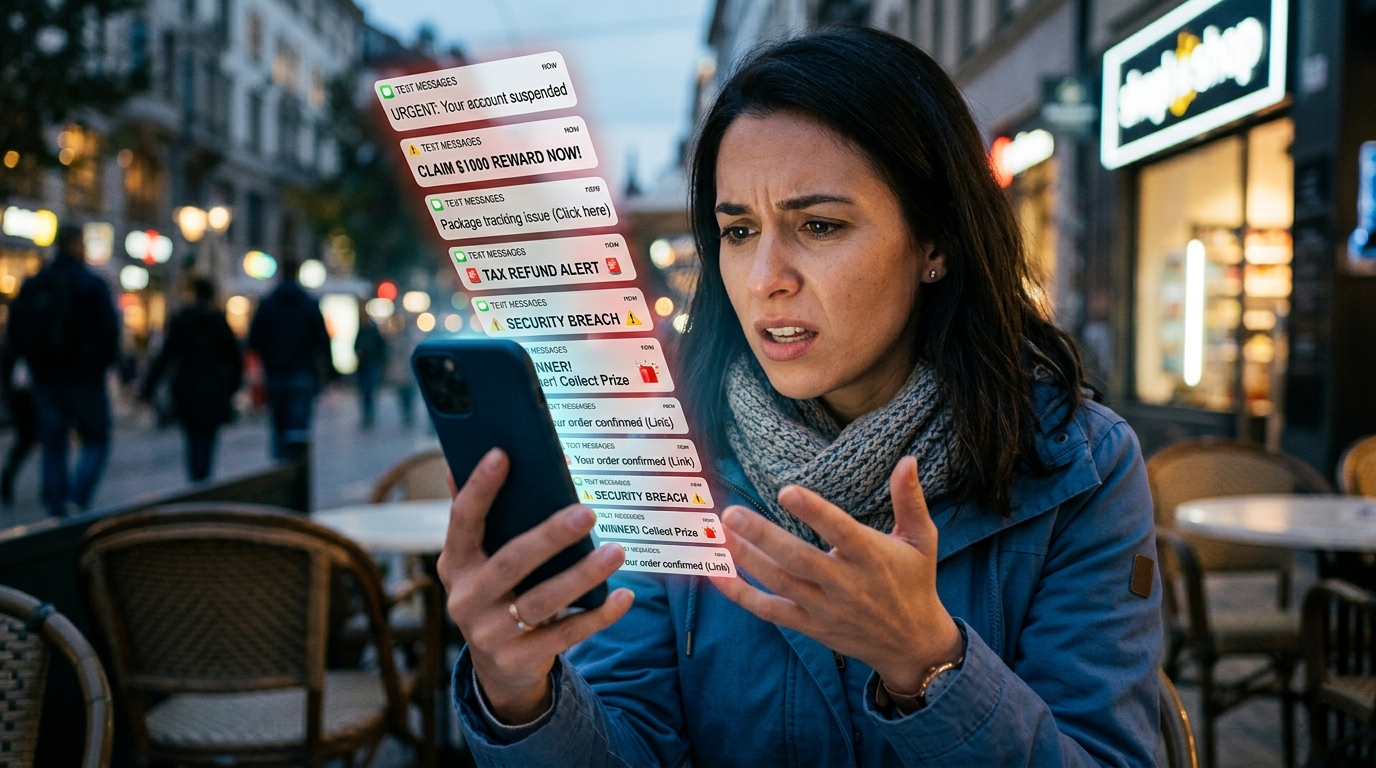
A fake delivery notification. An urgent alert from your bank. A text about unpaid tolls on a highway you've never driven.
If your phone feels like it's under siege, you're not imagining it.
Americans received roughly 19 billion robotexts in 2024 — nearly triple the volume from just three years earlier. And the problem is accelerating. According to Pew Research, 61% of American adults now receive scam texts at least once a week. For many people, it's become a daily nuisance. But the more troubling development isn't just the volume. It's the quality.
Modern scam texts often know your name. Sometimes your bank. Sometimes your city. They don't feel like spam — they feel like someone who has some idea of who you are.
That's not an accident. And it's not a coincidence. It's the direct result of how much personal data circulates freely online.
There's a reason the fraud industry shifted toward texting. More than half of consumers text daily, making it more common than any other communication method, including voice or email. Scammers go where attention is.
But the bigger factor is personalization. Fraudulent messages have become dramatically more effective because they're increasingly built on real information about real people. Phone numbers, names, addresses, family relationships, and purchasing history circulate across hundreds of databases — many of which consumers have never knowingly interacted with.
That data comes from everywhere: mobile apps, loyalty programs, social media accounts, online purchases, public records, marketing platforms, and past data breaches. Over time, those fragments get aggregated, bought, and sold — assembled into detailed consumer profiles that scammers can access cheaply and easily.
A text that knows your name and your bank doesn't require sophisticated hacking. It just requires a database.
The formats shift constantly, but a handful of approaches dominate. According to the FTC, the most commonly reported text scam in 2024 was fake package delivery — messages impersonating USPS or other carriers claiming a problem with an incoming shipment. Bogus job opportunities, fake bank fraud alerts, phony toll notices, and "wrong number" scams that slowly build fake relationships rounded out the top five.
What these tactics share is a deliberate design to create urgency before skepticism kicks in. A package you might be expecting. A charge that might be fraudulent. A toll you might have forgotten. The goal is an emotional reaction fast enough to bypass the part of your brain that would otherwise pause and question.
Scam attempts via text have grown sharply, with 30% of Americans who encountered a digital scam in the past year saying it started with a text or messaging app — up from 20% the year prior. Among younger adults, the jump is even more striking. Among 18- to 29-year-olds who reported a scam or cyberattack, 40% said it began via text. The year before, that figure was just 13%.
Most people, when they think about how scammers got their information, imagine a single breach. One hack. One bad password. One careless click.
The reality is more diffuse — and harder to address.
Your information likely exists across dozens of disconnected databases simultaneously. A retailer has your email. A delivery app has your phone number. A data broker site lists your address and the names of your relatives. No single source tells the whole story, but together they assemble an increasingly complete portrait of your identity.
This accumulation is what makes modern scams feel so unnervingly personal. Scammers aren't guessing — they're sourcing. AI now makes it faster and easier to comb through social media profiles, identify area codes for targeted text blasts, and build out detailed family networks for use in personalized fraud campaigns.
In 2024, consumers reported losing $470 million to scams that began with a text message — five times higher than the losses reported in 2020. And those are only the scams people reported. The FTC consistently notes that only a small fraction of fraud victims ever file a formal complaint.
No tool eliminates scam texts entirely. But reducing the underlying data exposure that makes them so effective is possible — and increasingly, it's something people are choosing to prioritize.
Some practical steps: enable multi-factor authentication, limit app permissions, use alternate email addresses for low-stakes signups, and avoid sharing personal details unnecessarily. These reduce the surface area of your digital footprint over time.
The harder piece is data broker removal. People-search and data aggregation sites are a primary source of the personal information that scammers use to make their outreach feel credible. About a quarter of Americans have already given up personal information to a scammer as the result of a predatory call, text, or email — in many cases without fully realizing it at the time.
The information that made those interactions convincing came from somewhere. Reducing how widely it circulates is one of the most direct ways to reduce your exposure — not just to scam texts, but to the broader fraud ecosystem they feed into.
¹ U.S. PIRG Education Fund / CBS News, Americans are getting 2.5 billion robocalls a month — cbsnews.com
² Pew Research Center, Online Scams and Attacks in America Today — pewresearch.org
³ Federal Trade Commission, Top Text Scams of 2024 — ftc.gov
⁴ Federal Trade Commission, New FTC Data Show Top Text Message Scams of 2024; Overall Losses Hit $470 Million — ftc.gov
⁵ Consumer Reports / 2025 Cyber Readiness Report, Text Message Scam Attempts Increased by 50 Percent — consumerreports.org
⁶ CNBC, 'Wrong number' text messages new payday for online scammers — cnbc.com